
Portrait of an Artist – Interview with Sculptor Kevin Hockley
by Joel Irwin
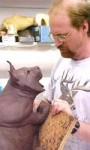
i)You’ve lived near Algonquin Park for quite some time. Can you explain the significance of Algonquin Park for your art?
Algonquin is the perfect blend of all elements that inspire art, particularly landscape and wildlife art. The rocks of the Canadian shield, the mixed forests of pine and sugar maple, its endless waterways and of course, the wildlife.
ii) Do you think artists share a special connection with Algonquin Park? If so, why?
There is something mystical in Algonquin that draws artists to paint and sculpt here. Perhaps it is the way the wispy bows of the giant white pine caress the sky; the rippling waters of its countless lakes and waterways sparkling like millions of gemstones; the rugged contrast of Algonquin’s granite outcroppings against her lush green forests; the earthy smell of the forest floor; a warm summers breeze whispering in the pines; the sight of a bull moose quietly feeding on water lilies – there is something that appeals to all of our senses, inspiring us to capture her beauty on canvas, film and bronze.
iii) In a piece like “Spirit of Algonquin”, you manage to capture not only the appearance, but the character of the Algonquin wolf. What kind of research goes into the production of such a piece?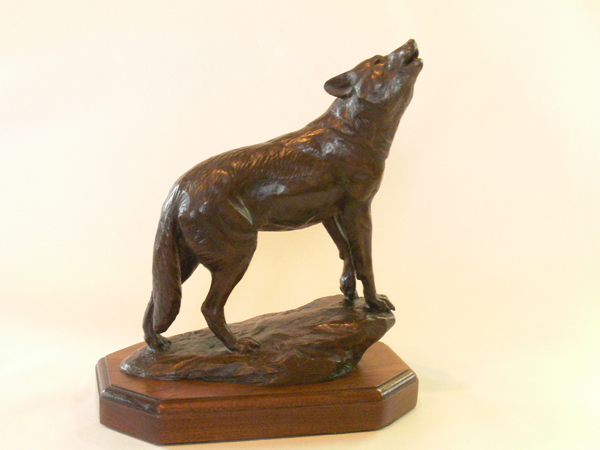
Most of my research involves studying live models in zoos, and in the wild. I have been privileged to view Algonquin wolves on several occasions. I supplement my live model work with videos and photographs supplied by park researchers and naturalists. The combination of my personal sightings and acquired reference allow me a thorough understanding of the subject’s behavior and physiology.
iv) Have you ever encountered a wolf in Algonquin Park? If so, can you describe what this experience was like?
Encountering wolves in the wild is always a magical experience. Frequently, while interior camping, the howls of nearby packs have penetrated the darkness. For me, wolf music is deeply moving, like a symphony resounding in the chambers of a great concert hall. Wolves, by nature, are very shy and secretive animals. This makes chance encounters that much more edifying. On one occasion, I recall my path converging with a particularly brazen individual. A typical reaction would have been for the animal to slink off into the woods, but this individual seemed to accept my presence and allowed me to snap several photographs, while making observations of his form between frames. When it finally disappeared I was left with an incredible feeling of awe, having been privileged to observe such a beautiful animal in its natural habitat.
v) I understand you’ve been commissioned to create a 50 ft snake for the Smithsonian? Can you tell us about this creature and the process of creating such a large work?
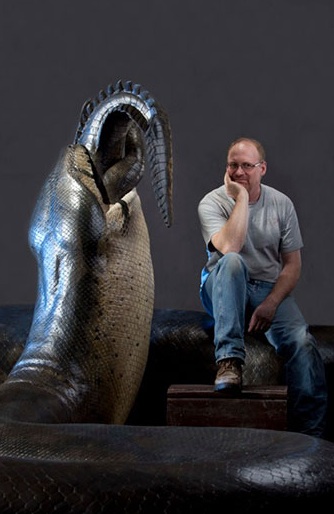 Several years ago a paleontologist at the Smithsonian Tropical Research Institute, and scientists from the University of Florida, University of Toronto and Indiana University unearthed fossils of a prehistoric snake in northern Colombia. To tell the story of the discovery, the producers at the Smithsonian Channel wanted a full-scale replica of the creature that would be incorporated into a 90 minute documentary. The snake, however, was not your typical garter snake or rattlesnake, which I typically replicate, but Titanoboa, a 2,500-pound , 50 foot long constrictor that lived 58 million years ago. The first step to building the replica was coming up with a pose. I produced a scale model in clay, an inch of which represented a foot of the actual replica. The snake’s body forms two loops, where museum visitors can wander. I tried to make it interactive, so you can actually get in and feel what it is like to be surrounded by a snake. I stacked large sheets of 12-inch-thick Styrofoam high enough to make a snake with a 30-inch circumference. The pose was drawn on to the Styrofoam and used a chainsaw and fish filet knives to carve the snakes body. Next I applied a layer of polyester resin and fiberglass cloth to strengthen it. On top of that, epoxy putty was applied and the scale texture was embossed onto this with rubber texture molds. Once the scales were complete, the entire model was primed and painted. The dark markings were established first followed by layering shades of olive over top to achieve the depth of color desired.
vi) Do you think that Art reveals something about nature that cannot be revealed otherwise?
An artists investigation of a subject is not limited to the physical level, but involves a deeper, more spiritual understanding. The finished works serve as a vehicle for expressing his perception of a subject- perceptions that align knowledge of the physical form with the spirit of the work. While these themes may not be stated explicitly, through interaction and interpretation we are moved to consider issues beyond the narrative.


